Glossary
#
- 6S Pyramid

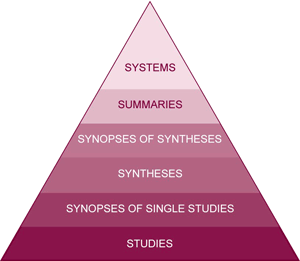
A way to find the best research evidence with the least amount of time and effort. Each level of the pyramid includes research evidence from the lower layers. By searching at the top level, you can find the highest quality and most synthesized research evidence first.
DiCenso, A., Bayley, L., & Haynes, B. (2009). Accessing pre-appraised evidence: fine tuning the 5S model into a 6S model. Evidence-Based Nursing, 12(4), 99-101.
A
- Absolute Risk Difference
The difference in rates between intervention and control groups, usually reported as a percentage. Found by subtracting one event rate from the other. Occurs when the risk in the intervention group is less than the risk in the control group.
Cullum, N., Ciliska, D., Haynes, R.B., & Marks, S. (2008). Evidence-Based Nursing. An Introduction. Oxford: Blackwell.
- Application
See Knowledge Application.
B
- Bias
An error in the design, conduct or interpretation of a study that may distort the truth (e.g., selection bias can occur when the way in which participants are assigned to one group or another distorts the results of the study).
Cullum, N., Ciliska, D., Haynes, R.B., & Marks, S. (2008). Evidence-Based Nursing. An Introduction. Oxford: Blackwell
- Blinding (masking)
The extent of awareness the patients, clinicians, assessors and/or data analysts have of the group to which patients were assigned in an experimental study.
Cullum, N., Ciliska, D., Haynes, R.B., & Marks, S. (2008). Evidence-Based Nursing. An Introduction. Oxford: Blackwell.
C
- Capacity Development
The development of knowledge, skills and attitudes within individuals and groups of people. The creation of structures, resources, policies and procedures in organizations and networks to sustain and achieve relevant goals, to cope with complexity and to innovate.
- Case Control Study
An observational study that identifies two groups—participants with an outcome of interest or health problem, and control participants without the interest or problem—and tries to identify the risk or causal factors associated with the outcome or problem (e.g., identify patients with and without lung cancer and looking back in time to determine past smoking behaviour and exposure to tobacco).
Dawson-Saunders, B., Trapp, R.G. (1994). Basic and Clinical Biostatistics. Norwalk: Appleton & Lange.
- Case Report
A report on a person specifying signs, symptoms and progression of illness.
- Case Series
A report on a series of patients with an outcome of interest with no comparison group.
- Cohort Analytic Study
A study in which participants who do not have the outcome of interest are assigned to a specific group: experimental (receive alternative treatment/therapy/interventions), comparison (receive standard/conventional treatment/therapy/interventions) or control (receive no treatment/therapy/interventions). Follow-up determines whether participants experience the outcome of interest.
DiCenso, A., Guyatt, G., & Ciliska, D. (2005). Evidence-based nursing: A guide to clinical practice. St. Louise: Elsevier-Mosby.
- Cohort Study
A group of individuals with a set of characteristics that are followed for a period of time to determine the incidence of an outcome; there is no comparison group.
Cullum, N., Ciliska, D., Haynes, R.B., & Marks, S. (2008). Evidence-Based Nursing. An Introduction. Oxford: Blackwell.
- Collaboration
A process of interaction where actors work together to achieve desired outcomes.
Glossary of Health Knowledge Management Terms, NHS Evidence - knowledge management http://www.library.nhs.uk/knowledgemanagement/Page.aspx?pagename=GLOSSARY
- Community of Practice
Voluntary, flexible networks of people with a common interest who learn about, share knowledge and develop expertise on an issue.
National Collaborating Centre for Methods and Tools. (2009). Networking in Public Health: Exploring the Value of Networks to the National Collaborating Centres for Public Health. Hamilton, ON: Robeson, P. http://www.nccmt.ca/pubs/NetworkingPaperApr09EN_WEB.pdf
- Comparison Group
Study participants who receive the conventional therapy/treatment instead of the experimental therapy/treatment.
Cullum, N., Ciliska, D., Haynes, R.B., & Marks, S. (2008). Evidence-based nursing. An introduction. Oxford: Blackwell.
- Confidence Interval (CI)
A measure of uncertainty, usually reported as 95% confidence interval. It represents the range of values within which you can be 95% sure that the true value for the entire population lies.
- Confounders
A variable that affects the relationship between two other variables (e.g., alcohol consumption is related to lung cancer but does not cause the disease; instead, both are related to smoking (the confounder), which causes lung cancer).
Crombie, I.K. (1996). The pocket guide to critical appraisal: A handbook for Healthcare Professionals. London: BMJ Publishing Group.
- Continuous Data
Data with a potentially endless number of values along a continuum (e.g., weight, blood pressure).
Crombie, I.K. (1996). The pocket guide to critical appraisal: A handbook for Healthcare Professionals. London: BMJ Publishing Group.
- Control Group
Participants in a study who receive no intervention/treatment/therapy and who provide a baseline against which to measure the effects of the treatment. When a study does not involve a true experimental design, this group may also be called the comparison group.
Polit, D. F., & Hungler, B. P. (1999). Nursing research: Principles and methods (6th ed.). Philadelphia: Lippincott.
- Critical Appraisal
The process of carefully and systematically examining research to judge its trustworthiness, value and relevance in a particular context.
Burls, A. (2009, February). What is critical appraisal? Retrieved from http://www.medicine.ox.ac.uk/bandolier/painres/download/whatis/What_is_critical_appraisal.pdf
- Cross-sectional Study
An observational study that examines a characteristic and the outcome of interest in participants at one point in time. Sometimes referred to as a survey study.
Cullum, N., Ciliska, D., Haynes, R.B., & Marks, S. (2008). Evidence-Based Nursing. An Introduction. Oxford: Blackwell.
D
- Data extraction
The process of capturing information about a knowledge translation method or tool to help the user decide if it relevant to their needs. The Measurement and Descriptive Information (MADI) Tool was developed from a range of critical appraisal checklists to critically appraise the method or tool. The MADI Tool gathers the following information about the method or tool:
- Content (sections of the resource, etc.)
- Relevance for public health
- Evaluation history and measurement (reliability, validity) characteristics
- Development (how the resource was developed)
- Access issues (cost, format, language)
- Implementation issues (participants, time, resources needed)
- Supplementary resources
- Current contact person
For more information, see Registry Methodology.
- Decision makers
People who work in the public health field, ranging from frontline public health providers (e.g., public health nurses, environmental health inspectors, dental hygienists, health promoters, etc.) to administrators (e.g., medical officers of health, program managers) and policy makers.
- Dichotomous Data
Data that has one of two values (e.g., dead or alive, symptoms present or absent). Also known as binary data.
Cullum, N., Ciliska, D., Haynes, R.B., & Marks, S. (2008). Evidence-Based Nursing. An Introduction. Oxford: Blackwell.
- Discussion Forum
An online space in which people can share knowledge about a common interest.
- Dissemination
A process used to spread new or existing knowledge, interventions or practices. Includes identifying the appropriate audience and tailoring the message and medium to that audience. Dissemination activities include: providing summaries/briefings to stakeholders; holding educational sessions with patients, practitioners and/or policy makers; engaging knowledge users in developing and executing dissemination/implementation plans; creating tools; and engaging the media.
For more information, see Registry Methodology.
- Doing
The middle stage of knowledge translation, between planning and evaluation. Resources include implementation methods and tools used to facilitate or perform knowledge translation activities. For example, methods to assist in rolling out a new program to practitioners are part of the doing stage of a dissemination strategy.
E
- Evaluation
A method of assessing the effectiveness and impact of knowledge translation activities in relation to their objectives, using quantitative and/or qualitative approaches (e.g.., tools to determine the effectiveness and impacts of a dissemination strategy).
- Evidence
Information, findings or facts that are systematically obtained in a way that is replicable, observable, credible, verifiable or basically supportable.
- Evidence-based Decision Making
The use of the best available evidence from relevant research to inform practice and policy decisions regarding health care, health systems and population and public health programs.
- Evidence-based Medicine (EBM)
The use of the best-available evidence to make decisions about the care of individual patients.
- Evidence-informed Decision Making (EIDM)
The use of evidence from a variety of sources to make decisions about the best use of resources within institutions and across the health care system.
- Evidence-informed Practice (EIP)
The use of high-quality evidence to make public policy decisions with the goal of improving health and reducing health inequalities. Address three questions to inform practice:
- What are the best solutions to the most burdensome health problems?
- What are the best ways to fit these solutions into complex, and often over-stretched and under-resourced, health systems?
- What are the best ways to bring about the desired changes in health systems?
EIP involves sifting, collating, analyzing and sharing the existing evidence, practice and experience, identifying implications for future practice and coming forward with relevant strategies and plans.
Method/Tool:
A standardized procedure or product that facilitates access to and/or use of information for decision making (e.g., a systematic approach or a set of organized steps or rules for accomplishing knowledge synthesis, dissemination and/or exchange; an instrument, guideline or manual used to inform and/or conduct knowledge synthesis, dissemination and/or exchange).
- Evidence-informed Public Health (EIPH)
The process of using the best available evidence, whether from research or from actual practice, to inform and improve public health practice and policy.
- Exposure
Contact with something that influences the development of an outcome or improves the outcome for a person (e.g., exposure to something that causes an increased risk for developing a disease or, in people who already have the disease, reaching a particular endpoint).
Cullum, N., Ciliska, D., Haynes, R.B., & Marks, S. (2008). Evidence-Based Nursing. An Introduction. Oxford: Blackwell.
F
- Forum
An online grouping of related threads of discussion for people with common interests.
I
- Inclusion Screening
A process used to assess resources generated by a search strategy to determine which should be included in a set of research or a study. For example, NCCMT’s Registry uses three inclusion criteria to determine appropriate resources:
- The resource must contain a method and/or tool.
- The method/tool must be used for one of the four types of knowledge translation activities.
- The resource must be relevant to/adaptable for use in public health contexts.
The Inclusion Screening tool guides this process.
For more information, see Registry Methodology.
- Intention-to-treat Analysis
A process where all patients are analyzed in the groups to which they were randomized, even if they failed to complete the intervention or received the wrong intervention.
- Intervention
The aspect of interest in an observational study. Interventions can be therapeutic (e.g., different wound dressings), preventative (e.g., influenza vaccination), diagnostic (e.g., measuring blood pressure) or organizational (e.g., implementing computerized systems).
Cullum, N., Ciliska, D., Haynes, R.B., & Marks, S. (2008). Evidence-Based Nursing. An Introduction. Oxford: Blackwell.
K
- Knowledge
The capacity for effective action that results from information, including familiarity, awareness and understanding gained through experience or study. It results from making comparisons, identifying consequences and making connections.
Tacit knowledge
Knowledge that resides within people in an organization and is not formalized into written or documented forms; accessible only through conscious efforts.Explicit knowledge
Knowledge that is available in spoken or written form; arranging data and information according to well-defined, formalized procedures or rules.
- Knowledge Application
Knowledge translation activities carried out to put knowledge into action in practice settings or circumstances, including adoption, uptake, use and mobilization. Purposefully doing something with the information and figuring out how to use or apply it most effectively. Other terms commonly used for this knowledge translation activity are adoption, uptake, utilization and mobilization. An important part of this activity is figuring out how to use the evidence appropriately or effectively within the local context. For example, developing a protocol to support a new program is an application activity.
- Knowledge Broker
A person or organization that facilitates creating, sharing and using knowledge by linking actors with each other or with knowledge and knowledge-related resources.
- Knowledge Dissemination
The process of distributing information to appropriate recipients and adapting content and the means of delivery for the intended audience(s). Activities and tools include briefing documents, educational sessions or workshops, online reviews, summary statements and publishing in journals.
- Knowledge Exchange
Collaborative problem solving and information sharing between researchers, research users and decision-makers. It results in mutual learning and awareness, which inform policy, program and research decisions. A knowledge broker linking a public health unit to research organizations or a partnership between researchers and practitioners for an initiative are examples of exchange activities.
- Knowledge Integration
The effective incorporation of knowledge into the decisions, practices and policies of systems and organizations so that it informs and affects outcomes.
- Knowledge Management
The systematic application of policies, methods and tools to create, capture, share and leverage the knowledge needed for an organization to succeed.
Clemmons Rumizen, M. (2002). The complete idiot's guide to knowledge management. Indianapolis, IN: Alpha Books.
- Knowledge Synthesis
An activity for assessing current research evidence and expert opinion and providing a more comprehensive perspective on a specific topic. Syntheses identify gaps in evidence to help establish future research priorities and provide information to support policy and program decision making. The components are: identifying a question/problem of interest; establishing criteria to inform study selection; searching literature for relevant research; appraising studies critically; combining study results statistically/thematically; and summarizing synthesis findings. Both researchers and practitioners can synthesize evidence. Developing public health practice guidelines are an example of synthesis.
- Knowledge Transfer
The process of passing on research knowledge from producers to potential users.
- Knowledge Transfer and Exchange (KTE)
An interactive process involving the interchange of knowledge between research users and researcher producers. KTE is facilitated by two-way communication, networking opportunities, relationship development and interactive engagement of key stakeholders. Activities focus on building and maintaining relationships between researchers, policy makers and senior managers.
National Collaborating Centre for Methods and Tools. (2009). Networking in Public Health: Exploring the Value of Networks to the National Collaborating Centres for Public Health. Hamilton, ON: Robeson, P. http://www.nccmt.ca/pubs/NetworkingPaperApr09EN_WEB.pdf
- Knowledge Translation
A systematic process for sharing knowledge between researchers and research users, including the synthesis, dissemination, exchange and ethically sound application of knowledge. The goal is to improve the health of Canadians, provide more effective health services and products and strengthen the health care system.
adapted from CIHR
- Knowledge Uptake
The process of acquiring, reviewing and using research knowledge, and incorporating it into decision making.
M
- Mean
The average of a set of numbers, calculated by summing all scores and dividing by the number of subjects.
Polit, D.F., Beck, C., & Hungler, B.P. (2001). Essentials of nursing research: Methods, appraisal, and utilization. (5th ed.) Philadelphia, PA: Lippincott Williams & Wilkins.
- Measurement and Descriptive Information Tool (MADI)
A data extraction form developed to prompt reviewers to look for specific information about a method or tool. For the NNCMT Registry, it includes: evaluation history and measurement (reliability, validity) characteristics; relevance for public health (specifically designed or adaptable for use in public health); development (who, when, where, why); content (questions, components, activities); access considerations ( cost, format, language); implementation issues (participants, time, needed resources/skills, steps); supplementary resource materials; current contact person/source.
For more information, see Registry Methodology.
- Meta-analysis
A method for combining the results of several studies that measure the same outcomes so that an overall summary statistic can be calculated.
- Method
Standardized processes, approaches or steps that facilitate access to and use of information for knowledge translation and decision making (e.g., a framework to create a dissemination plan).
National Collaborating Centre for Methods and Tools. (2009). Networking in Public Health: Exploring the Value of Networks to the National Collaborating Centres for Public Health. Hamilton, ON: Robeson, P. http://www.nccmt.ca/pubs/NetworkingPaperApr09EN_WEB.pdf
N
- Networking
A system on interconnected individuals, groups or organizations and the links between them.
National Collaborating Centre for Methods and Tools. (2009). Networking in Public Health: Exploring the Value of Networks to the National Collaborating Centres for Public Health. Hamilton, ON: Robeson, P. http://www.nccmt.ca/pubs/NetworkingPaperApr09EN_WEB.pdf
- Number Needed to Treat (NNT)
The number of patients who need to be treated to prevent one additional negative event (or to promote one additional positive event). Calculated as 1/absolute risk reduction (rounded to the next whole number), with a 95% confidence interval.
O
- Odds Ratio (OR)
The odds of a patient in the experimental group having an event divided by the odds of a patient in the control group having the event; or, the odds that a patient was exposed to a given risk factor divided by the odds that a control patient was exposed to the risk factor.
Cullum, N., Ciliska, D., Haynes, R.B., & Marks, S. (2008). Evidence-Based Nursing. An Introduction. Oxford: Blackwell.
- Orientation
A typical pattern of activities and connections through which members experience being a network, such as meetings, open-ended conversations, projects, content, access to expertise, relationships, individual participation, community cultivation and serving a context.
- Outcome
The target variable of interest (or dependent variable) that is hypothesized to depend on or be caused by another variable (independent variable).
DiCenso, A., Guyatt, G., & Ciliska, D. (2005). Evidence-Based Nursing: A guide to clinical practice. St Louis: Mosby.
P
- p Value
A statistical value related to the probability that the obtained results are due to chance alone; p < 0.05 means that there is less than a 1 in 20 probability that the result is occurring by chance alone.
Cullum, N., Ciliska, D., Haynes, R.B., & Marks, S. (2008). Evidence-Based Nursing. An Introduction. Oxford: Blackwell.
- Phenomenology
A research approach that emphasizes the complexity of human experience and the need to understand that experience holistically, as it is actually lived.
- Planning
The initial stage of knowledge translation, before the doing and evaluation stages. Planning methods and tools are used when thinking about how to frame, approach or organize knowledge translation activities. For example, a planning tool with a work plan and checklist for actions can be used to help prepare a dissemination strategy.
- Pre-appraised Research Evidence
Evidence that has been reviewed for methodological rigour, synthesized, and in some cases further summarized into key messages.
Ciliska D., Thomas H., & Buffett C. (2008). An introduction to evidence-based public health and a compendium of critical appraisal tools for public health practice. Hamilton: National Collaborating Centre for Methods and Tools. Retrieved from http://www.nccmt.ca/pubs/2008_07_IntroEIPH_compendiumENG.pdf
Robeson, P., Dobbins, M., DeCorby, K., & Tirillis, D. (2010). Facilitating access to pre-processed research evidence in public health. BMC Public Health, 10, 95.
- Pre-processed Research Evidence
Evidence that someone has synthesized, and in some cases further summarized into key messages.
Robeson, P., Dobbins, M., DeCorby, K., & Tirillis, D. (2010). Facilitating access to pre-processed research evidence in public health. BMC Public Health, 10, 95.
- Prognostic Factors
Study participant characteristics that indicate increased or decreased risk of a positive or negative outcome.
DiCenso, A., Guyatt, G., & Ciliska, D. (2005). Evidence-Based Nursing: A guide to clinical practice. St Louis: Mosby.
- Public Health
An organized activity or way of thinking designed to promote, protect, improve and/or restore the health of individuals, specific groups or the entire population. A combination of sciences, skills and values aimed at protecting and improving the health of all people. The term “public health” can describe a concept, a social institution, a set of scientific and professional disciplines and technologies and a form of practice. It is a way of thinking, a set of disciplines, an institution of society and a manner of practice. It has an increasing number and variety of specialized domains and it demands of its practitioners an increasing array of skills and expertise.
adapted from the Public Health Agency of Canada
Q
- Qualitative Research
Research that aims to describe and explain complex, unquantifiable phenomena, such as people’s attitudes, experiences or perceptions (e.g., phenomenology, grounded theory, participatory action research and ethnography).
R
- Random Allocation
The assignment of study participants to groups by chance to ensure that all participants have an equal chance of being assigned to either the experimental or comparison/control group. Controls for factors that may affect the outcome of the study.
DiCenso, A., Guyatt, G., & Ciliska, D. (2005). Evidence-Based Nursing: A guide to clinical practice. St Louis: Mosby.
- Random Sampling
A method of randomly selecting participants for a study to ensure that different parts of the population being sampled are equally likely to be selected. Also known as probability sampling.
Cullum, N., Ciliska, D., Haynes, R.B., & Marks, S. (2008). Evidence-Based Nursing. An Introduction. Oxford: Blackwell.
- Randomized Controlled Trial (RCT)
A study design in which individuals are randomly allocated to receive alternative interventions, and then followed up with to determine the effect of the interventions (one of the alternatives might be no intervention).
Cullum, N., Ciliska, D., Haynes, R.B., & Marks, S. (2008). Evidence-Based Nursing. An Introduction. Oxford: Blackwell.
- Relative Benefit Increase (RBI)
The proportional increase in the rates of good outcomes between experimental and control participants, which is reported as a percentage. RBI is calculated by dividing the rate of the good outcome in the experimental group (EER) minus the rate of the good outcome in the control group (CER) by the rate of the good outcome in the control group: EER – CER/CER.
DiCenso, A., Guyatt, G., & Ciliska, D. (2005). Evidence-Based Nursing: A guide to clinical practice. St Louis: Mosby.
- Relative Risk (RR)
The proportion of patients experiencing an outcome in the treatment (exposed) group divided by the proportion experiencing the outcome in the control (unexposed) group.
Cullum, N., Ciliska, D., Haynes, R.B., & Marks, S. (2008). Evidence-Based Nursing. An Introduction. Oxford: Blackwell.
- Risk Factor
A patient characteristic associated with the development of a disease.
DiCenso, A., Guyatt, G., & Ciliska, D. (2005). Evidence-Based Nursing: A guide to clinical practice. St Louis: Mosby.
S
- Search Strategy
A strategy to gather relevant knowledge translation methods and tools. These resources are then screened to determine if they will be included in the Registry (see Inclusion Screening).
For more information, see Registry Methodology.
- Statistical Significance
A measure indicating that results obtained in an analysis are unlikely to have occurred by chance and the null hypothesis is rejected (i.e., there is a difference in outcome between the groups). When statistically significant, the probability of finding the result by chance falls below a specified level of probability (most often p<0.05).
- Study
An original research investigation published in a journal.
DiCenso, A., Bayley, L., & Haynes, B. (2009). Accessing pre-appraised evidence: fine tuning the 5S model into a 6S model. Evidence-Based Nursing, 12(4), 99-101.
- Summary
The integration of the best available research to provide a full range of evidence.
- Summary Writing
The final step in producing a summary statement of a knowledge translation resource for the Registry. Information from the data extraction tool, the Measurement and Descriptive Information (MADI) Tool, is transferred to the Summary Writing Template to complete the writing process.
For more information, see Registry Methodology.
- Synopsis
A brief description of original articles and reviews, such as those that appear in evidence-based journals.
Haynes, R.B. (2007). Of studies, syntheses, synopses, summaries and systems: the "5S" evolution of information services for evidence-based healthcare decisions. Evidence-Based Nursing, 10, 6-7.
- Synopsis of a Study
A brief summary of a high-quality study that can inform clinical practice.
- Synopsis of a Synthesis
A summary of the findings of a high-quality systematic review that often includes a commentary on the methodological quality of the review and the applicability of its findings.
- Synthesis
A systematic review that comprehensively summarizes all the research evidence related to a focused question.
- Systematic Review
A summary of all evidence related to a particular question (e.g., dealing with intervention effectiveness, causation, diagnosis or prognosis). The systematic review process follows a rigorous methodology for searching, retrieval, relevance, quality rating, data extraction, data synthesis and interpretation.
Cullum, N., Ciliska, D., Haynes, R.B., & Marks, S. (2008). Evidence-Based Nursing. An Introduction. Oxford: Blackwell.
- Systems
The computerized decision support systems that link individual patient data to the best evidence that matches their specific circumstances.
T
- Tool
Standardized products such as instruments, surveys and checklists that facilitate access to and use of information for knowledge translation and decision making (e.g., a checklist for a dissemination plan).
V
- Variable
An attribute of a person or object that changes (e.g., body temperature, age, heart rate).
Polit, D. F., & Hungler, B. P. (1999). Nursing Research: Principles and Methods (6th ed.). Philadelphia: Lippincott.