Critical appraisal tools to make sense of evidence
The Critical Appraisal Skills Programme (2006)
UK
How to cite this summary:
National Collaborating Centre for Methods and Tools (2011). Critical appraisal tools to make sense of evidence. Hamilton, ON: McMaster University. (Updated 16 December, 2011). Retrieved from http://www.nccmt.ca/registry/view/eng/87.html.
Keywords : Appraise
These summaries are written by the NCCMT to condense and to provide an overview of the resources listed in the Registry of Methods and Tools and to give suggestions for their use in a public health context. For more information on individual methods and tools included in the review, please consult the authors/developers of the original resources.
Relevance for Public Health |
The Critical Appraisal Skills Programme (CASP) tools can be used to teach critical appraisal skills in a wide variety of settings, including public health. To learn more about using the CASP tools to improve public health practice, see the NCCMT's Online Learning Modules. For example, the Critical Appraisal Skills Programme (CASP) tools can be used to appraise and summarize the evidence on bullying prevention among children and youth to inform local programming. |
Description |
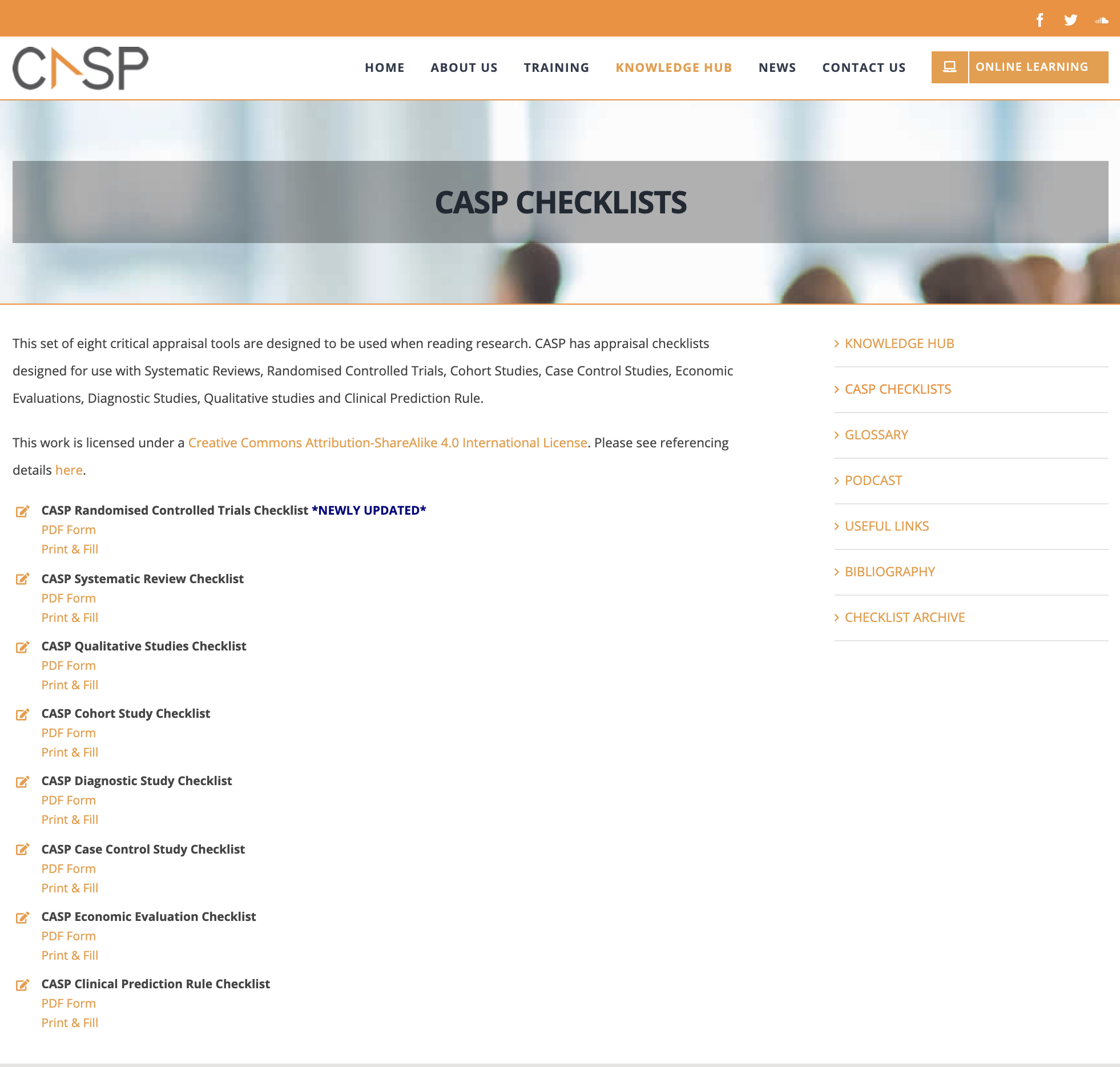
The Critical Appraisal Skills Programme (CASP) helped to develop an evidence-based approach in health and social care, working with local, national and international groups. CASP aims to help individuals develop skills to find and make sense of research evidence, helping them to apply evidence in practice.
All critical appraisal tools consist of three sections to assess internal validity, the results and the relevance to practice. The CASP appraisal tools were developed from guides produced by the Evidence Based Medicine Working Group published in the Journal of the American Medical Association. |
Implementing the Method/Tool |
|
Steps for Using Method/Tool |
Each Critical Appraisal Skills Programme (CASP) appraisal tool asks three broad questions:
Each of the seven appraisal tools includes 10–12 questions. The first two questions are screening questions; if the answer is yes to both, it is worth proceeding with the remaining questions to assess the study. Prompts are given with each question to remind the user why the question is important.
|
Who is involved |
Any individual interested in learning how to critically appraise research evidence could use the CASP tools. |
Conditions for Use |
Not specified |
Evaluation and Measurement Characteristics |
|
Evaluation |
|
Validity |
Not applicable |
Reliability |
Not applicable |
Methodological Rating |
|
Method/Tool Development |
|
Developer(s) |
The Critical Appraisal Skills Programme Solutions for Public Health National Health Service, UK website: http://www.casp-uk.net/
|
Method of Development |
The CASP checklists were developed using a four-stage process:
The members of the multidisciplinary working groups had backgrounds in public health, epidemiology or evidence-based practice. |
Release Date |
2006 |
Contact Person/Source |
Amanda Burls website: http://www.casp-uk.net/ |
Resources
Title of Primary Resource |
The Critical Skills Appraisal Programme: making sense of evidence |
File Attachment |
None |
Web-link |
http://www.casp-uk.net/ |
Reference |
Public Health Resource Unit (2006). The Critical Skills Appraisal Programme: making sense of evidence. Public Health Resource Unit, England. Retrieved from: http://www.casp-uk.net/ |
Type of Material |
Website |
Format |
On-line Access |
Cost to Access |
None |
Language |
English |
Conditions for Use |
Copyright © 2006 Public Health Resource Unit, England |